

|
Latest News October 2010 Improved nylons for automotive and electronics use Another new Durethan TP 424-009 (to be known as AKV 30 G HR DUS 023 in the future) is targeted at pipes used in vehicle engine compartments. This hydrolysis-stabilised 30%-filled PA66 incorporates an additive that allows for gas and water injection processing for hollow parts with large pipe cross-sections and complex geometries with branches, flattened cross-sections and large angles. A 60%-filled DP BKV 60 H2.0 EF grade, meanwhile, offers stiffness for automotive engineering use as an alternative to metals and glass mat-reinforced thermoplastics (GMTs). Its tensile modulus of 19,000 MPa is twice standard-filled PAs. It has recently been used to produce a spare wheel recess with integrated reinforcing channels in the new Audi A8. In its Pocan PBT range, Lanxess has added on three blends for exterior truck components. The high heat-resistant A3131 is a 30%-filled PBT+ASA blend for structured geometrical thinwall parts like wind deflectors and door extensions. With better flowability (40%) and toughness (30%), a key strength of the PBT+PC C3230 XF is its minimal distortion. It is ideal for lamp housings and large panels/trims. Meanwhile, the 55%-filled T3150 XF is for structural reinforcement that require stiffness and strength. It boasts a high elasticity modulus of 18,500 MPa, panning it as an alternative to plastic/metal composites. Green nylon and ABS for electroplating Other properties are its chemical resistance and low water uptake, since over 60% of the base polymer comes from renewable resources. The product was recently approved by energy management specialist Schneider Electric for circuit breakers, sockets and switch bodies. In its Terluran ABS line, BASF has developed an electroplating grade. Studies conducted at the L�denscheid Plastics Institute show a broad processing window and compliance to adhesion testing on a complex grid plate. The BX 13074 is intended for plumbing fixtures like water faucets, shower heads and other shiny surfaces in bathrooms and kitchens while in the automotive sector, it can be used for radiator grilles and trim strips. The first operational plates for flushing mechanisms have already been made by Werrit. August 2010 Chinese market for
IMMs grows The company says the high growth was due to the demand for IMMs from the building/construction, home appliances and electronics industries. It was also boosted by the Chinese government's adoption of a series of measures like domestic demand expansion, economic development promotion and industrial revitalisation planning as well as the VAT reform that encouraged companies to invest. The report details production, sales, import/export, competition and segments of the Chinese IMM market. In addition, the report focuses on the major production areas and top producers. For instance, Ningbo in the Zhejiang province supplies over half the Chinese market demand and has about a one-third share of the global market. Machine manufacturers located in the area include Haitian International, Chen Hsong Group, LK Group, Germany's Demag and Japan's Sumitomo Heavy Industries. In 2009, IMM sales in the Beilun district of Ningbo accounted for 45% of the total national sales and was valued at RMB6.4 billion. New machines and
control from Netstal Apart from fast cycles (2 seconds for the 280 model for a packaging application and 2.1 seconds for a closure application on the 220 model to be shown at the K), the machines offer 30% lower investment, says the company. As for the aXos, the upper screen includes a membrane keyboard for manual operation to show the status, axis positions and user-specific markings while the lower screen's main innovations are a free programmable sequence editor and an auxiliary control definition page. The sequence editor allows processors to build their own customised process sequence, without having to rely on Netstal engineers to create a programme specifically for the moulding operations. Patrick Blessing, Head of R&D; at the company, said, "Today our machines have a fixed sequence that can be influenced with a parameter set of more than 15,000 parameters. With aXos our customers are free to programme any sequence their process requires. There won't be any limitations and any inconsistencies in the programme will be highlighted before activation." The control will be paired with the new hybrid machines at the show and will be ready for devlivery next year. July 2010 StackTeck gains entry into Asian markets Matrix, founded in 2007 by a team of industry specialists, has focused its business on integrated solutions that can be customised for each application. StackTeck specialises in the development and manufacturing of injection moulds in the areas of thinwall, in mould labelling, beverage closures and consumer packaged goods. Chen Hsong banking on Chinese growth In fact, the increasing demand in China saw its earnings increase by 13% to HK$1.8 billion while sales to overseas markets declined by 22% to HK$338 million and sales to Taiwan went down by 42% to HK$109 million. However, its sales to the domestic market in China allowed the company to double its profit to HK$208 million. During the second half of the financial year, the company says it aggressively expanded its capacity, especially for large tonnage injection moulding machines, restarted supply chains and trained new workers, with the goal to raise overall production capacity back to the level before the global financial crisis. In painting a picture for the future, the company, said, “Visibility continues to be low for the world economy during the next financial year (i2010/2011), with equal prospects for negative as well as positive developments. On the positive side, China will continue to grow in a steady but relatively rapid pace, targeting a healthy GDP growth of over 8%. On the negative side, a multitude of economic indicators all point to a general lack of resiliency in the US economic recovery; the European Union continues to be plagued by sovereign debt crises and substantial pressure on the Euro with little prospects of short-term improvements.” As such, the company says it will continue to focus its energies on China as well as seek growth in certain developing countries. As a result of its efforts on R&D, the company says it was able to introduce new products including the New Age computer control system and the MJ20-H servodriven micromoulding machine. Chen Hsong’s New Age control system is based on what it says are leading edge industrial control technologies, advanced EtherCAT industrial I/O bus and the TwinCAT automation control system. Its MJ20-H machine is equipped with German company Bosch Rexroth’s servo control system, an all-hydraulic centre-applied clamping design, balanced injection cylinders, high-strength linear guide rails and the New Age control system. June 2010 Nissei’s machine for high-heat PLA Yoda claimed the 80 tonne machine it has developed is capable of consistent moulding of the additive-free, 100% PLA material. “The machine also caters to a high temperature of 120°C, which is double previous models,” he said, adding that he believed Nissei was the first in the world to offer a machine with these capabilities. “We want to cater to the high heat PLA grades that are being developed by suppliers. These materials usually have poor flow at high temperatures and have been difficult to process in the past.” The new machine is in line with the Japanese company’s plans to expand its portfolio to include new technology like nanomaterials and metal and paper injection moulding. It has already sold one machine to a Japanese customer who will use it to mould products for the medical, packaging and cosmetic sectors. PCs open the window to lighter cars The Japanese company says its Panlite resin is half the weight of glass and over 200 times more resistant to impact. Besides offering transparency, heat/weather resistance, moisture retention and workability, it causes no optical distortion, making it suitable for windows. Teijin Chemicals also boasts one of the world’s largest two-component rotary injection moulding machine, which is equipped with four-axis parallelism control to maintain the mould’s parallel balance in a process known as plastic glazing. This control is said to reduce strain and warpage, which tend to increase as moulded parts become larger. The machine presses parts as fast as 35 mm per second and moulds uniformly thin parts without compromising resin fluidity, according to Teijin. As a result, Teijin says it is now is capable of producing 2.2 sq m single-piece moulds for two-component panoramic roof systems and body panels. Late last year, Teijin established a new business unit that consolidates all the functions related to the development and marketing of PC resins for automotive applications. That same month, glazed Panlite was used for the first time in the quarter and partition windows of the LFA, Lexus’ two-seat super car. The result has been a 40% weight reduction compared to glass, with no loss of visual clarity or external appearance. Looking ahead, Teijin Chemicals now intends to further refine its integrated moulding technology for windows, frames and bodies, hoping to open up new markets for these advanced automotive products in Asia and Europe. May 2010 Last year, it set up a subsidiary in Germany, Zhafir Plastics Machinery, to produce all-electric machines for the European market. “We will introduce a prototype all-electric machine for the packaging sector at the K show. This will be assembled in Europe for the European market,” said Franz, adding that the company will start selling the machine in 2011. German technology for Engel moulds The EF-E unit is a two-stage system based on a FIFO injection system mounted horizontally above the pressure platen. It is supplied in combination with an All-Out piston injection unit mounted vertically in front of the horizontal unit. There is a rapid cure element between the horizontal unit and the vertical piston injection unit that increases the temperature of the elastomer melt by dissipation. The advantage of this new technology is a more homogeneous temperature distribution in the molten material, increasing the temperature in the centre of the flow other than the edges. Steinl’s patented All-Out technology also ejects all the molten material into the mould. Injection and holding pressures can be up to 36,000 psi. Since the melt is injected into the mould at a higher temperature than previous systems and because the material is already at a high temperature, the vulcanisation period is reduced by 50%. Moving into micromoulding While Arburg says its machines already had the ability to handle small shot weights with conventional small diameter screws, its new micro-injection unit is aimed to compete in the dedicated micromoulding sector. Unlike other alternatives on the market that use a combination of screw plasticising and piston injection, Arburg’s has two screws for the preparation, dosing and injection of material. It has a plasticising screw/shooting pot configuration and for the piston to inject the melt it has a second screw. Makers of screw plasticising/plunger injection machines may say that a smaller diameter can be achieved with a plunger than with a screw, so for a given shot volume, it has a longer, and therefore more controllable, stroke. Arburg, meanwhile, says that the 8 mm screw diameter combined with the degree of control it is able to achieve over stroke, gives the necessary control over shot volume. But the use of a screw instead of a plunger overcomes what Arburg claims is the failure of screw/plunger combinations, allowing for a first-in first-out operation. Furthermore, the 8 mm screw has no plasticising function and serves to convey the melt from the plasticising screw forwards at a steady rate and inject it. A pressure sensor is used to ensure that the melt is fed forward consistently. The plasticising screw, which can be a standard 18-20 mm screw and is mounted piggyback at 45 degrees, can process conventional granulate. It is not necessary to use the more expensive micro-pellets that are also limited in grades. And when not needed for micro-moulding, the machine can be fitted with a conventional 12 or 16 mm screw. Arburg has also succeeded in fully maintaining the modularity of its components with this new development. The micro-injection module is designed specifically for use on electric Allrounder A machines with a size 70 injection unit. Its enclosed construction means that it can be changed rapidly and then used on various machines, like any other Arburg cylinder module. This also means that the range of the machine's applications is not limited to micro-injection moulding. Consequently, other larger cylinder modules can also be used on this machine when a product change is required. Challenging year for European injection moulding market Up until 2008 the European injection moulding sector had been growing by around 2% a year by polymer volume, but the last quarter saw a sharp contraction in the market which wiped out nearly five years of growth in the space of a few months. This year, AMI is forecasting an expansion in polymer demand in the range of 3-4% a year over the next three years driven mainly by developments in packaging applications and specialised areas like medical, healthcare and defence and by general growth in the markets of Central and Eastern Europe. The recession has served to accelerate the process of rationalization, which has been going on in injection moulding for many years now. Since 2005 more than 12% of sites have closed in Western Europe, although the number has been growing in Central and Eastern Europe. AMI’s analysis suggests that the number of moulding sites in Europe will reduce by a further 10% over the next three years. In addition to the impact of the recession, which led to an increase in bankruptcies, the industry has also been affected by the retirement of owners unable to sell on their business and by plant rationalisations among the larger groups. The relocation of capacity to lower cost locations outside Europe also continues to occur, while other operators have just withdrawn from injection moulding preferring to contract out their injection moulding requirements or have refocused their activities on tooling, assembly or finishing operations or moved into non-plastic activities. The sectors which AMI has found to be most affected by these trends were suppliers to the automotive industry, particularly of small and medium-sized components. Similarly small and medium sized electronic and appliance manufacturing has declined significantly in Europe and with it the moulding sector to supply it. In general it is sectors which have low growth opportunities, low specialisation and commodity pricing which are most likely to move out of Europe. The expansion of the EU has also resulted in a growing shift of moulding capacity from For the period 2005 to 2008 polymer demand among Central and Eastern European moulders grew on average by 7% a year while in Western Europe polymer consumption by moulders shrank at a rate of 1% a year. The injection moulding industry in nearly all of Western Europe declined over this period, with the exception of Germany that actually managed to sustain positive growth, in part aided by its proximity to the growing markets of Central and Eastern Europe, the relative strength of its manufacturing industries and strong consumer demand up to Q3 2008. The UK injection moulding sector has been the weakest of the major West European countries, with the market declining even during 2006 and 2007, when most other markets were growing on the back of stronger economic growth. The UK has suffered from a decline in foreign investment more attracted to the euro zone or the growing markets of Eastern Europe and significant reductions in automotive, electronics, household appliances and consumer goods manufacturing. While AMI expects to see the European injection moulding industry returning to growth during 2010, the market will remain intensely competitive with profitability challenged by the pressures of customers and rising raw material, energy and labour costs. The number of companies involved is expected to continue to decline, although the industry structure will remain fragmented, involving as it does over 12,000 companies the majority of which are single site, local service providers. April 2010 Alliance to manufacture small plastic cars The alliance will focus on sharing the development and production of chassis and engines. The move will involve a cross-shareholding giving the three companies a small, symbolic stake in each other. Renault and Nissan will each take on a 1.55% stake in Daimler, which in turn will take a 3.1% stake in each of the other two. Nevertheless, Renault and Daimler will keep separate identities for their brands, even if the engines that power the cars will be similar. According to Renault’s Carlos Ghosn, each brand will have its own identity, products, cost and price level. The cooperation will include developing a common chassis for Daimler's Smart Fortwo and Renault's Twingo, both small cars. The partnership will also extend to sharing engines with Daimler's Mercedes-Benz using Renault-Nissan engines for its future line-up of premium compact cars and Nissan's Infiniti using four and six cylinder engines from Daimler. The deal was pushed by what Ghosn says is the European Union’s restrictions on a vehicle’s average carbon dioxide emission by 2012, something that can be achieved by lower fuel consumption. The three companies expect to save US$2.7 billion as well as generate additional sales over the first five years. The savings will be made through sharing of production and development costs as well as economies of scale through joint purchasing. Lower sales for machine makers Haitian says its sales developed positively in the first two quarters of 2009. It chalked up sales of RMB1.37 billion, compared to the previous year, which it says was its best in its 43 years history. In spite of the world crisis at the end of 2008, it managed to sell 16,000 machines. The economic trend continued into 2009 and was made worse by the declining consumption and export business of its customers, says the company. Nevertheless, the company maintained its position. But the situation in the Chinese market improved after the first quarter 2009, supported by the government’s RMB4 billion stimulation package and further consumption and investment to revitalise the economy. The profitability of the group, thus, improved significantly as a result of this market improvement in the second quarter of 2009. In the second quarter a 58.2% increase in sales was generated, representing RMB842.2 million in value of machines. It also pointed to the continuing trend of energy saving machinery like its Mars series that climbed in the first half year to around RMB567 million. This represents a growth of 15.5% compared with the record figures of the first two quarters of 2008. Meanwhile Husky, which also manufactures robots, PET preform moulds and hot runners, generated sales of C$1.14 billion compared to the figure of C$1.3 billion in 2008. Owned by private equity firm Onex Corp., Husky’s higher sales of 13% in Latin America managed to offset the lower sales it had in the US, Europe and Asia. India’s anti-dumping duty on Chinese machines The country started the investigation two years ago after local machinery producer L&T complained about the lower prices of the Chinese machines. The ten companies (Borch, Sound Machinery, Golden Eagle, Liguang Machinery, Haixing, Tederic, Haitian, Heavywork Machinery, Huayuan Machinery and Smargon Plastic Machinery) affected will be inflicted with duty ranging from 76-174%, while other Chinese companies face a standard rate of 223%. New LFT process for cost-effective pallet production Lomold worked on the project with its partners Taiwanese machinery maker Chuan Lih Fa (CLF), South African KHS Consulting and Netherlands-based Addcomp Holland. Lomold's high-performance LFT PP pallet, made of 17% fibreglass-reinforced PP, is said to show a unique racking performance, with no creep under high loading. The development was carried out in-house by a team of engineers over a period of ten years and the technology is now patented worldwide. Several years ago, an exclusive cooperation with CLF resulted in the development of the Lomolder machines, with several machines (different sizes) having been built already. The main difference between conventional injection moulding and the new process is the modified melt-delivery system, which uses a large piston as a plunger to force melt into the tool through a single 100 mm gate. The fill portion of the moulding cycle is 60% faster than straight injection moulding of a comparably sized part, coming in at 7 seconds for a 16 kg pallet and the melt is delivered at far lower shear, filling at less than one-twentieth the melt velocity of injection moulding. This helps preserve fibre length and reduce shear heating and post-mould warpage, while nearly reducing the clamp tonnage required in half. The plunger/piston face closes off the mould's bounding wall during the end of stroke, sealing the tool, and during the pack-and-hold portion of the cycle, a second piston meters out the next shot so there is no lag between finished part ejection during mould open and recharging for the next shot once the mould closes again. The ability to maintain fibre lengths in intricate 3D designs is a hallmark of the process, which therefore yields parts with high mechanical properties at thinner walls, lower mass and with resulting cost reduction. Parts with longer reinforcing fibres benefit from better low temperature impact strength, higher mechanical properties at elevated temperatures, better dimensional stability at any wall thickness, enhanced creep and fatigue resistance – critical in a part like a pallet – and excellent surface finish. The pallet is also fully recyclable at end of service life. The company plans to launch a second generation, multi-piece pallet in several configurations later this year. This newer pallet’s design has proven to be lighter (allowing greater material and logistical savings) and the flexibility and functionality of its unique configuration allows it to be used in multiple markets. The company is also setting up a facility in Huzhou, China, to produce its pallets for the local market. Lomold plans to produce its pallets at 22 additional locations on six continents as demand grows. March 2010 Plugging in with hot runners The 06E threaded/screw fit manifold nozzle is said to further enhance the Synventive small-sized line of threaded leak-proof manifold nozzles. Available with both thermal gate and valve gate options, the 06E features a 6 mm flow bore (with 20 mm mould cut-out) and is designed for small shot weights up to 100 g per nozzle. Since these nozzles are threaded into the manifold, a leak-proof system is provided without critical stack up dimensions that must be maintained. These nozzles are externally heated and are available in lengths from 60-200 mm. The nozzle heaters are easily replaceable and have integrated, replaceable thermocouples. When the new 06E nozzles are used as a valve gate system and combined with a Synventive bolt-on actuator, the complete hot runner system is supplied pre-wired and pre-hosed for plug and play mould installation. The PNC30 pneumatic bolt-on valve gate actuator is said to simplify hot runner installation. It has features like a cover plate to allow valve pins to be removed and/or adjusted without removing the top clamp plate; top clamp plate that can be removed without removing valve pins from the hot runner; no pneumatic or cooling hoses as these are gun-drilled directly into top clamp plate and no side force/load on valve pins due to bolt-on design. In other news, Synventive recently announced that it had appointed an agent in Vietnam, OssTech. February 2010 Compact and affordable Deemed to be its lowest priced hydraulic range, the Magna Toggle (MTH) line comes in a range of 35-400 tonnes clamping force. The machines designed by Milacron's Ohio manufacturing facility in collaboration with its global operations team, offers a mono-toggle version ranging from 35-90 tonnes, and a 10-pin double-toggle configuration ranging from 125-400 tonnes, the latter with automatic lubrication. The MTH features an electronically-controlled variable-volume pump, with only two manifolds for the injection unit and clamp. This series offers processors better repeatability, quicker response and fewer hydraulic connections, says the company. Completing the line is a servo system (MTS) that replaces the standard induction motor, and in this case, an electro-hydraulic pump is replaced by an internal gear pump, resulting in lower inertia and a highly dynamic speed control system. The servomotor can vary from 0-3000 rpm in both directions, whereas the induction motor is limited to 1750 rpm. The higher rpm delivers more torque for the same power delivered. The line will be delivered from stock, however, a host of options are available including PVC and thermoset kits, core pulls and air eject.
Temperature controllers made easy It also features a 16 l capacity, which is double that of conventional systems. The oval shape of the trough ensures ideal mixing of the coolant; the stainless steel construction guarantees a long service life. Research on saving energy
PC glazing push in Japan January 2010 Chemtura exiting PVC additives business Chemtura, which filed for Chapter 11 bankruptcy protection last year, said that it will make SK Capital the lead “stalking horse” bidder for its additives business in the auction sale. Other companies can also make bids for the business. The PVC additives unit makes tin stabilisers, liquid and solid mixed metals, liquid phosphite esters, epoxidised soybean oil, thiochemicals, organic-based stabilisers and impact modifiers. It has plants in the US and Europe, including facilities in Lampertheim, Germany, and Taft, US. In 2008, the business had sales of US$374 million. SK Capital also owns Aristech Acrylics and Ascend Peformance Materials, which it bought from Solutia. Elastogran has a new name First gas-phase PP produced in China The Unipol technology that produced Aim grade PP resin marked a major breakthrough for the two companies. “The successful trial-run of the first Unipol PP unit in China is a tremendous achievement for Datang and for Dow and is a direct result of our continued strong commitment to the plastics industry in the region,” says Dave Jerger, Senior Improvement Leader for Unipol PP Licensing & Catalyst. The Datang plant located in Duolun County, Xilinguole, Inner Mongolia Autonomous Region, is also the first large scale coal to olefin plant in China. Once fully operational, the plant will produce 460,000 tonnes of PP per year. “Since 2006, seven PP plants in Asia have chosen Unipol technology. The simple and safe design, low investment and extremely economical production process of this technology makes it an attractive solution,” says Jerger. DSM expands footprint Carpet manufacturer Shaw Industries and DSM Chemicals North America were previously joint venture partners in NPC. With this acquisition, DSM is able to fully integrate with the PA6 chain, including caprolactam, polymer and compounded products in the US. DSM is also the only company to produce the entire PA6 chain in China. Speaking of the acquisition, Koen Devits, President of DSM Engineering Plastics Americas said that it helped the company to fully exploit its backward integration at the American site, where DSM also produces caprolactam, a key raw material for Akulon PA6. He added, “The acquisition is also needed to support the additional sales opportunities we have generated, especially in the automotive, furniture and packaging industries." More petrochemicals in the Middle East To be housed in Ras Laffan Industrial city, Qatar Petroleum and ExxonMobil’s project will include the 1.6 million tonnes cracker, two 650,000 tonnes gas phase PE plants and a 700,000 tonnes ethylene glycol plant. Start-up of the proposed facility is estimated in late 2015. The project will use ExxonMobil’s proprietary steam cracking and PE process and utilise feedstock from gas-development projects in Qatar’s North Field, which is the largest non-associated gas field in the world. ExxonMobil says its proprietary steam cracking furnace technology boosts ethylene yield, allows greater feedstock flexibility, reduces energy consumption and extends time periods between maintenance. ExxonMobil’s olefins plants throughout the world utilise the technology and the company licenses it as part of the Score ethylene process. Meanwhile, Equate’s US$2 billion complex for producing paraxylene (PX) and benzene (BZ) is located in Kuwait’s Shuaiba Industrial Area. The current capacities are 829,000 tonnes/year of PX and 393,000 tonnes/year of BZ. PX is the main feedstock in the production of PET. The complex’s PX output will be marketed by Petrochemical Industries in selected markets while the BZ will be used locally for the production of styrene monomer by the Kuwait Styrene Company (TKSC). Thai company sued by Eastman Chemical Indorama, which is currently starting up a new PET plant in the US and in 2008 purchased Eastman’s PET plants in the UK and the Netherlands, said in a statement that the lawsuit relates to “certain patent, technology licensing and trade secret matters” while not elaborating further. The company’s units that are affected include Alphapet, Indorama Polymers Rotterdam and Indorama Polymers Workington. The company also said that it believes these claims are without merit and it intends to vigorously defend against the claims. US-based Eastman Chemical filed the lawsuit late last year alleging patent infringement, breach of contract and trade secret misappropriation. The patent infringement claims relate to three Eastman patents that encompass PET manufacturing technology. The breach of contract and trade secret claims arise from Indorama’s unauthorised disclosure and use of information covered by a license agreement between Eastman and several European Indorama entities. Ticona expands LFT business FACT or Future Advanced Composites Technology is a business unit of the Ravago Group and producer of LFT used in injection moulding, extrusion, compression moulding and blow moulding applications. The acquisition will support Celanese's Advanced Engineered Materials business segment of which Ticona is a unit and build upon its LFT process technology by broadening specific product offerings. FACT has a workforce of around 60 at Kaiserslautern while Ticona makes Celstran LFT at Kelsterbach. Ticona has set up a new company that will combine its existing Celstran business with that of FACT and will shift its production into FACT's plant by mid-2011. Reliance ups offer for LyondellBasell According to the story in the Indian Business Standard, this is more than the previous offer of US$12 billion in cash. Meanwhile another story in the Wall Street Journal, says that LyondellBasell's board had rejected Reliance’s revised offer saying that the company is worth US$15.5 billion. A controlling stake in the Netherlands-based LyondellBasell, which is the world's third largest independent chemical company and the largest polyolefins maker, would allow Reliance access to the US market. South Korean firm makes bid for Styron A Dow Jones report, quoting an unnamed Lotte spokesperson, said that the company had not made a final decision yet. The report also said that the deal is worth between US$1 to US$2 billion. Lotte is involved in the plastics industry through Honam Petrochemical that produces HDPE, PP and MEG. December 2009 Ferromatik sales plunge Husky sets up in India High flow LDPE The Lupolen 1800U grade professes to have better processing characteristics than LLDPE, which is widely used in packaging, housewares and caps and closures. “At 60 g per 10 minutes, the grade achieves the highest melt flow rate that has ever been produced within our European portfolio of LDPE grades,” said Christof Justus, PE Manager at LyondellBasell. With its high flow rates, the resin can also be considered for use in additive masterbatches and as a viscosity modifier for compounds. The grade also contributes to good dispersion and homogenisation of pigments and additives, says Justus, adding that it achieves thermal stability without the use of additives unlike LLDPE. The grade will be produced on a commercial scale in LyondellBasell’s European Lupotech T plants. November 2009 Covering for components The company opened a CoverForm Competence Centre in Darmstadt, Germany, recently for this process. KraussMaffei developed the machine technology while Evonik developed the required product combination of a speciality compound (Plexiglas cf moulding compound) and a multi-component solvent-free reactive system on an acrylate base for the functional coating. The CoverForm solution is said to substantially cut fabrication costs for scratch-resistant and chemical-resistant components since no coating is required. Targeted applications include the automotive and lighting industries, in optics or in communications and display applications. The centre will also be used to further develop reactive systems as well as new anti-reflective or electrically conductive coatings, said the company. The solution will be launched in Europe first and will be available in the US and Asian markets in 2010. Haitian shifts European hq Haitian Europe, which intends to capture a larger market share in Germany, will from June next year be based near Nuremberg. It will market its Haitian and Zhafir machines in Europe. Based in Ebermannsdorf, Germany, about two hours drive from Nuremberg, Zhafir Plastics Machinery is a wholly owned company of Haitian that was set up in 2005. The machines its produces are designed and assembled in Germany. Having invested over EUR10 million into its German operation, Zhafir recently completed the expansion of its facility, after less than eight months construction. With the completion of the assembly building, the first model of the all-electric Venus Series will roll off the production line in November. Zhafir will also be producing its new high performance Mercury machine series at its Ebermannsdorf facility from next year and expects to showcase this model at the K2010 show. IML labelling for thinwall cups The high speed results from the interaction of a manufacturing cell consisting of an Engel 180/55 injection moulding machine and a hot runner mould from Glaroform. The four-cavity mould from Glaroform loads the Engel machine with a shot weight of 41 g. With a wall thickness of 0.5mm, each cup has a net weight of 10.25 g. By means of a side handling, Beck Automation places the labels and simultaneously takes out the completed cup. October 2009 Giant in the hot runner controls business Set up in 1974, PMS supplies controllers to a number of hot runner system suppliers, including Mold-Masters. "Mold-Masters and PMS have worked together for many years in the development and supply of the highest quality and performance micro processor based temperature controllers." said Jonathon Fischer, President and CEO of Mold-Masters. "This seamless working relationship has enabled our two companies to take the next natural step and become a single company. We believe strongly in the strengths of PMS and together we will create additional value for our growing customer base." said Fischer. Mold-Masters will also be retaining the PMS distributor network, which includes IMSI. Multi-component moulding made easy In the technology known as SCPS (servo-cavity positioning systems), the entire control sequence of the mould, including the drives for all other injection units, the hot runner control equipment and core pullers, is handled by the mould's own control system. All movements are servo-driven and independent from the machine hydraulics. The mould is built with the progressive stages through the injection sequence stacked on top of one another. The indexing components move up through each stage and when they reach the top they are transferred from one mould half to the other and returned down to the first stage, operating like a paternoster conveyor. The indexing components are carried up by a spindle in the moving half of the tool. Injection takes place simultaneously at all stations. After the mouldings have passed through the final injection station they are lifted clear of the top of the mould for removal by a robot. When the mould closes, each indexing component is transferred to a spindle in the nozzle half and on the next opening stroke is carried down to the bottom of the mould where on closing it is once more located on the upward spindle. The time taken to open the mould, index to the next station and close again is around 3 seconds. Mould cavity processes combined RocTool has an induction heating process where the induction coil is wrapped around the mould while Indumold uses induction heating circuits integrated in the mould. Development of both systems will continue and both will be available for demonstration at Lüdenscheid and at the Pôle Européen de Plasturgie in France. RocTool also recently launched an induction heating technology known as 3iTech – Integrated Internal Induction Technologies. Hot runner companies to cross-sell products The two American companies have been working together since 2003 with Beaumont providing hot runner designs with the MeltFlipper balanced manifold technology exclusively under license to Incoe for its Opti-Flo hot runner systems. Beaumont will also provide cold runner technology, including design services, and the new Rheological Control System (RCS) mould inserts. With this new partnership, Beaumont will be able to offer its customers hot runner systems from Incoe including Direct-Flo Gold and the recently introduced Quick-Flo.
German set-up in India September 2009 New paint line to reduce production times
The next stage in injection moulding machinery manufacturer KraussMaffei’s investment in a synchronised production flow line, which it is implementing at its production plant, is a paint line. The German company is investing EUR4 million on a surface treatment centre to replace the existing painting line at its biggest production plant, located in Allach on the outskirts of Munich. The goal was to synchronise the painting of machine parts with the assembly and return them to the assembly line as they are needed. With this, the company says it will reduce production times and also allow for a higher surface quality. The new line consists of an indexing system and a combined unit. In the indexing system, an overhead conveyor will feed parts that are 4 m long, 3 m wide, 3 m high and weighing up to 32 tonnes. The combined unit will be used to paint parts that are too big for the indexing system. This unit can handle parts up to 12 m long and up to 80 tonnes in weight. Preform moulds perform to a new tune Sold under the brand name of iPET Systems, the product range includes new moulds, conversions, retrofits, refurbishments, spare parts and service from five manufacturing locations and 40 sales and service offices globally. The moulds and hot runners are directly interchangeable with existing PET mould platforms and fit in all makes of injection moulding machines. Available from 2 to 192 cavities, the moulds come with up to four positions of post-mould cooling technology and offer new features. The proprietary design of the iFlow hot runner manifold has less pressure drop, fills more uniformly and generates less preferential shear stress than conventional gun drilled manifolds. The valve gate has been purpose engineered for moulding PET so it generates less PET dust, reduces crystallinity in the gate and makes in-press service easy. A patented technology called iCool, allows iPET moulds to cool more evenly and more efficiently. "We have recently spoken with a number of moulders and machine suppliers about iPET and they have been extremely positive about our approach. The market is looking for another global supplier of PET moulds and we believe that iPET will fill this need and provide the industry with new levels of performance," said Patrick Bennett, Executive VP of Mold-Masters. Husky offers sustainability to PET packaging The American company displayed its HyPET Recycled Flake (RF) system running a blend of 50% virgin and 50% rPET at the recent Drinktec show in Germany. The 72-cavity system produced a 34.7 g EcoBase preform at the same 10.5 second cycle that would be expected running 100% virgin PET. Enabling 2.5% additional resin savings, the EcoBase preform design was first introduced at NPE 2009 in Chicago earlier this year. System enhancements include in-line melt filtration to eliminate black specks and other contaminants that might otherwise affect bottle quality as well as a new extruder design for improved processing of pellet and flake blends. The company says these new features will encourage the use of rPET in the packaging industry. Husky has also been examining the complete life cycle of beverage packaging, including bottle and closure, to determine ways to improve the manufacturing process to make it more sustainable. It is working with the Allied Development Corporation, a third party consulting and publications company, to conduct life cycle analysis studies. These show how the environmental footprint and greenhouse gas emissions of manufacturing and transporting PET bottles relate to alternative forms of packaging. Besides the reduction in preform weight, Husky has also recently introduced its HyCAP system for high speed beverage closure manufacturing, in particular the lightweight, one-piece closures that are becoming increasingly common in beverage packaging. At Drinktec, Husky demonstrated the production of a 2.3 g PCO 1881 closure in a 72-cavity mould running at less than 3.9 seconds, which is lighter and faster than what Husky says was the previous industry standard of 2.8-3 g running at a cycle time of 4.8-6 seconds. The HyCAP is based on Husky’s Hylectric machine, with modifications to accommodate the requirements of viscous and closure materials that are difficult to mould.August 2009 Demag ties up with Sepro for robot The agreement is specifically for Sepro’s SDR three-axis robots that are offered in six models. These will be fitted on Sumitomo Demag’s Systec and IntElect machines from a clamping force of 35 to 2,000 tonnes. The SDR series is controlled by means of Visual 2 and this control system communicates with the machine via the Euromap-67 interface. Sumitomo Demag says it will add on its new NC5 control system in the future. The German machine company also uses another robot supplier, Wittmann, and will continue to offer the DR7 and DR8 series developed together with the Austrian supplier alongside the Sepro robots. Expansion of foam cell applications in Japan A key facet of this alliance will be research conducted by both companies to help develop high gloss Class A automotive parts using the MuCell process. Microcellular foaming technology was originally conceptualised and invented at the Massachusetts Institute of Technology (MIT) and in 1995 Trexel was granted an exclusive worldwide licence for the further development and commercialisation of the technology. Examples of MuCell products include electrical components, electronics connectors, internal business equipment and printer components, a variety of packaging applications and a broad array of automotive products including HVAC components and door trim and panels. July 2009
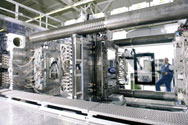
Window of opportunity with large machine The machine has been installed with localised clean room areas around the cavity, robot and packaging zones at BMS's Leverkusen plant in Germany and is capable of producing 3D roof modules measuring up to 1.2 sq m along with other complex glazing components. The facility is also designed for back-injecting pre-formed, printed films to integrate additional functions such as heating, antennae and IR reflection in roof modules, rear windows and other glazing applications. The Engel machine has a central swivelling platen for two-component injection, with shot a capacity of 1-6 kg for the first component and 0.2-3 kg for the second. It can operate injection-compression and is ready for the installation of MuCell for the second component, as well as for direct skinning and direct coating. It is also equipped with 17 temperature control units since high optical quality is required. The swivel platen is controlled separately with ten water feeds for 24 temperature control channels. BMS says, apart from research, it expects to use the machine for mould proving and production troubleshooting for its customers as part of its full service approach to supplying automotive glazing systems. Husky promotes benefits of PET packaging To support this goal, the firm is participating in several projects dedicated to providing accurate information about the safety, sustainability and recyclability of PET. “Recently, there has been increased public interest concerning the safety and environmental impact of plastics. Our goal is to educate the media and consumers so that they can make informed, fact-based decisions about PET packaging,” said Jeff MacDonald, Husky’s Vice-President of Marketing. He continued, “Studies have shown that PET is one of the most lightweight and recyclable packaging materials. As PET technology continues to advance, it is becoming an increasingly attractive packaging alternative for many applications.” In April 2008, Husky partnered with others in the plastics industry to launch the Facts on PET (www.factsonpet.com) campaign. The goal of Facts on PET is to dispel any misleading information such as the confusing information linking PET plastic products to those that contain bisphenol-A (BPA). The company says Facts on PET has been successful in correcting misleading reports and educating the mainstream media on the safety, recyclability and convenience of PET containers. Netstal offers used machines By running its own second-hand machine business, Netstal wants to give its existing and new customers the opportunity of acquiring injection moulding machines directly and thereby operating equipment revised by the original manufacturer. With this in mind the company has set up a department dedicated to the buying, overhauling and selling of used machines. Advantages are that the company has access to the original manufacturing documents and original spare parts, thus delivering machines in a condition nearly as new. Depending on the scope of the revision such moulding machines will be covered by a works warranty of up to 12 months. More information is available from www.netstal.com/2ndhand Engel acts like a bank to offer loans The flexible leasing and financing model involves a simplified approval procedure so that customers need not go through difficult negotiations with a bank. The Austrian company is also using its independent family-owned status to help customers raise money. After the usual credit checks, Engel can offer international customers loans to help cover current investment planning. In doing so, the company says it acts like a local bank, quickly and unbureaucratically closing financing gaps to beat the credit crunch. Ferromatik delivers large order to China The first delivery, comprising seven machines from Ferromatik’s high performance K-Tec and Maxima models with clamping forces of 350 to 650 tonnes, will be commissioned at Hayco’s facility in Shenzhen, Guangdong, before the end of the year. The machines will be used in the production of parts for the company’s liquid purification and dispensing products. The machines to be delivered include one for multi-component moulding while the others come with special features such as extended tiebars and modified machine interfaces. In business for 25 years, Hayco manufactures electro-mechanical products for a range of end markets, including oral and personal care, liquids delivery and household cleaning. The company already has 200 moulding machines ranging from 30 to 850 tonnes and its customers include Procter & Gamble and Wal-Mart Stores. |



|
|
|---|